
HEALING:
A TIBETAN BUDDHIST PERSPECTIVE
Compiled
by: Ven. Pende Hawter
|
What
is healing?
What
do we mean by healing? Do we mean healing of the physical body,
healing of the psyche/soul/mind, or both of these. What is the connection
between body and mind?
Many
modern healing techniques regard successful healing as the cure
of the presenting physical problem, whether this be symptoms of
cancer, AIDS, chronic fatigue syndrome, or some other illness. If
the person does not recover from the presenting physical problem,
or if that problem recurs or another develops at a later time, this
may be regarded as failure.
It
is not uncommon in these situations for the therapist or organisation
that has been helping the "sick" person to infer or state
that the person must have done something wrong, that they haven't
stuck strictly enough to the diet or meditated enough or done whatever
else it was that they were supposed to do.
In
these situations the person can become very guilty, depressed or
angry. In many cases, they just give up hope. To avoid these problems,
it is necessary to consider a more comprehensive view of healing
that incorporates not only physical healing but mental healing.
Mind
is the creator
To
understand healing from the Buddhist perspective, a useful starting
point is to consider the Buddhist concept of mind. The mind is non-physical.
It is formless, shapeless, colourless, genderless and has the ability
to cognize or know. The basic nature of mind is pure, limitless
and pervasive, like the sun shining unobstructedly in a clear sky.
The
problems or sickness we experience are like clouds in the sky obscuring
the sun. Just as the clouds temporarily block the sun but are not
of the same nature as the sun, our problems or sickness are temporary
and the causes of them can be removed from the mind.
From
the Buddhist perspective, the mind is the creator of sickness and
health. In fact, the mind is believed to be the creator of all of
our problems. That is, the cause of disease is internal, not external.
Unlimited
potential
You
are probably familiar with the concept of karma, which literally
means action. All of our actions lay down imprints on our mindstream
which have the potential to ripen at some time in the future. These
actions can be positive, negative or neutral. These karmic seeds
are never lost. The negative ones can ripen at any time in the form
of problems or sickness; the positive ones in the form of happiness,
health or success.
To
heal present sickness, we have to engage in positive actions now.
To prevent sickness occurring again in the future, we have to purify,
or clear, the negative karmic imprints that remain on our mindstream.
Karma
is the creator of all happiness and suffering. If we don't have
negative karma we will not get sick or receive harm from others.
Buddhism asserts that everything that happens to us now is the result
of our previous actions, not only in this lifetime but in other
lifetimes. What we do now determines what will happen to us in the
future.
In
terms of present and future healing, the main objective is to guard
our own actions, or karma. This requires constant mindfulness and
awareness of all the actions of our body, speech and mind. We should
avoid carrying out any actions that are harmful to ourselves and
to others.
Buddhism
is therefore a philosophy of total personal responsibility. We have
the ability to control our destiny, including the state of our body
and mind. Each one of us has unlimited potential - what we have
to do is develop that potential.
Healthy
mind, healthy body
Why
do some people get ill while others remain in the best of health?
Consider skin cancer. Of all the people who spend many hours out
in the sun, some will develop skin cancer and others will not. The
external situation is the same for all of them, but only some will
be affected. The secondary cause of the skin cancer - the sun -
is external, but the primary cause - the imprints laid down on the
mindstream by previous actions - is internal.
Also,
people with similar types of cancer will often respond quite differently
to the same treatment, whether this be orthodox or alternative.
Some will make a complete recovery. Some will recover temporarily
and then develop a recurrence. Others will rapidly become worse
and die. Logically one has to look to the mind for the cause of
these differences.
Buddhism
asserts that for lasting healing to occur, it is necessary to heal
not only the current disease with medicines and other forms of treatment,
but also the cause of the disease, which originates from the mind.
If we do not heal or purify the mind, the sickness and problems
will recur again and again.
This
introduces the notion of "ultimate healing". By ridding
the mind of all its accumulated "garbage", all of the
previously committed negative actions and thoughts, and their imprints,
we can be free of problems and sickness permanently. We can achieve
ultimate healing - a state of permanent health and happiness.
In
order to heal the mind and hence the body, we have to eliminate
negative thoughts and their imprints, and replace them with positive
thoughts and imprints.
The
inner enemy
The
basic root of our problems and sickness is selfishness, what we
can call the inner enemy. Selfishness causes us to engage in negative
actions, which place negative imprints on the mindstream. These
negative actions can be of body, speech or mind, such as thoughts
of jealousy, anger and greed.
Selfish
thoughts also increase pride, which results in feelings of jealousy
towards those higher than us, superiority towards those lower than
us and competitiveness towards equals. These feelings in turn result
in an unhappy mind, a mind that is without peace. On the other hand,
thoughts and actions directed to the well-being of others bring
happiness and peace to the mind.
Conscious
living, conscious dying
It
is important to consider what happens to us when we die. The Buddhist
view is that at the time of death the subtle consciousness, which
carries with it all the karmic imprints from previous lives, separates
from the body. After spending up to forty-nine days in an intermediate
state between lives, the consciousness enters the fertilised egg
of its future mother at or near the moment of conception. New life
then begins. We bring into our new life a long history of previous
actions with the potential to ripen at any time or in any of a myriad
ways.
The
state of mind at the time of death is vitally important and can
have a considerable effect on the situation into which we are reborn.
Hence the need to prepare well for death and to be able to approach
our death with a peaceful, calm and controlled mind.
Death
itself can be natural, due to exhaustion of the lifespan, or untimely,
due to certain obstacles. These obstacles arise from the mind and
can be counteracted in different ways. One method commonly employed
in Tibetan Buddhism to remove life obstacles is to save the lives
of animals that would otherwise have been killed. For example, animals
can be rescued from being slaughtered or live bait can be purchased
and released.
For
those with a life threatening illness, it is important to understand
that being free of that illness doesn't mean that you will have
a long life. There are many causes of death and death can happen
to anybody at any time.
Not
just pills and potions
Tibetan
medicine is popular and effective. It is mostly herbal medicine,
but its uniqueness lies in the fact that in the course of its preparation
it is blessed extensively with prayers and mantras, giving it more
power.
It
is said that taking such medicine will either result in recovery,
or, if the person is close to death, they will die quickly and painlessly.
(Another theory, based on personal experience, is that it tastes
so bad you want to recover quickly so that you can stop taking the
medicine!)
Blessed
pills and blessed water are also used extensively. The more spiritually
developed the person carrying out the blessings or the healing practices,
the more powerful is the healing result or potential. These pills
often contain the relics of previous great meditators and saints,
bestowing much power on the pills.
Many
Tibetan lamas actually blow on the affected part of the body to
effect healing or pain relief. I have seen a person with AIDS with
intense leg pain have his pain disappear after a lama meditated
intensely and blew on his leg for twenty minutes. Compassion is
the power that heals.
Visualisation
can also be very powerful healing. One method is to visualise a
ball of white light above your head, with the light spreading in
all directions. Imagine the light spreading through your body, completely
dissolving away all sickness and problems. Concentrate on the image
of your body as completely healed and in the nature of light.
This
type of meditation is even more powerful when combined with visualising
holy images and reciting mantras. I often tell my Christian patients
to visualise the light as Jesus, with the light emanating from him.
In
the Tibetan tradition, there are many Buddha figures (deities) which
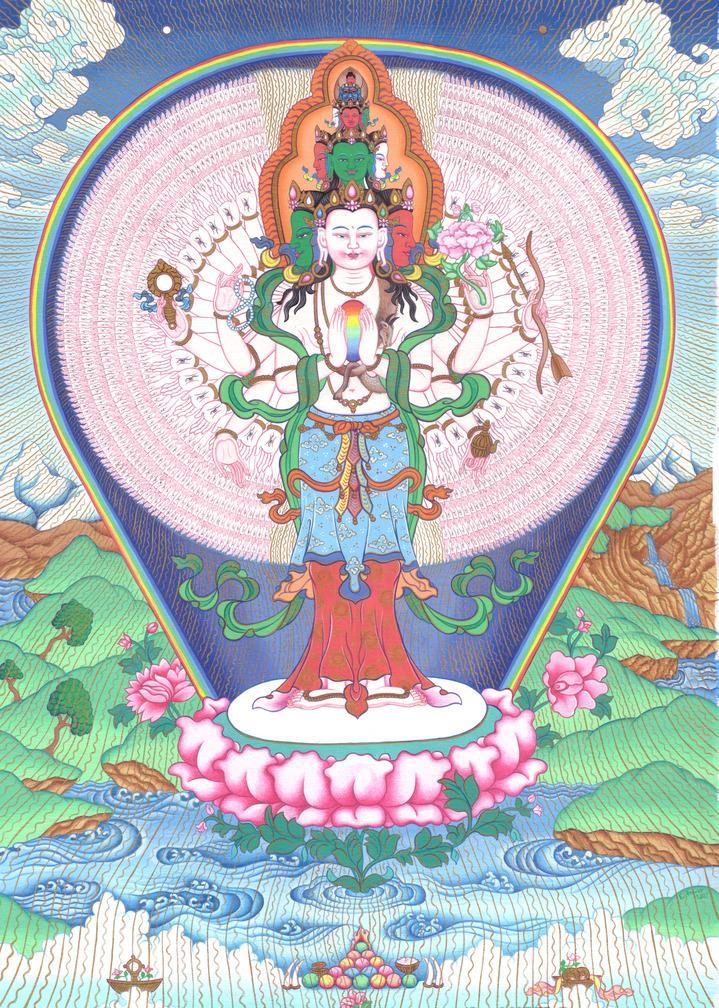
can be visualised while reciting their mantra. The Medicine Buddha;
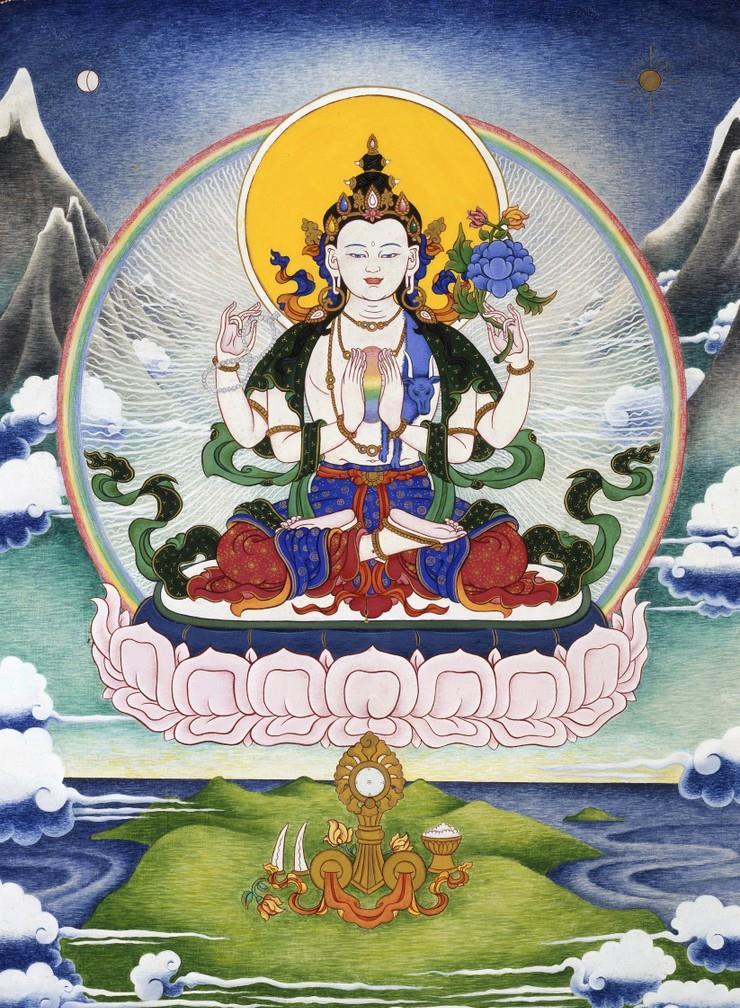
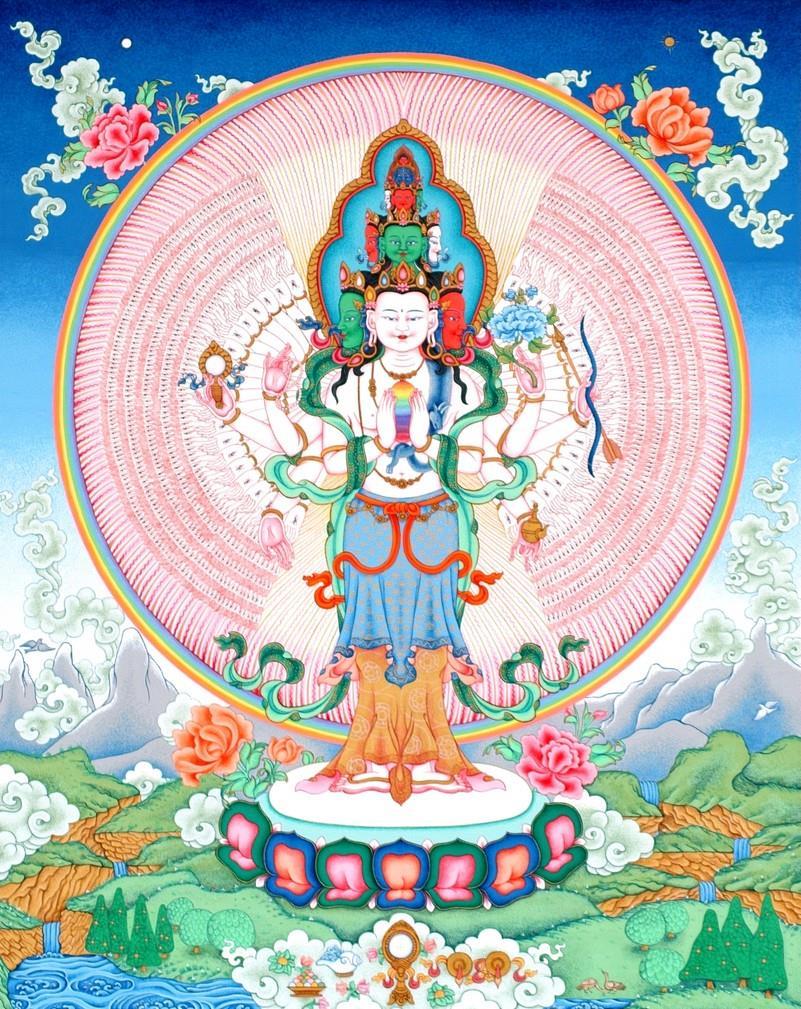
Chenrezig, or Avalokiteshvara (the Buddha of Compassion); or one
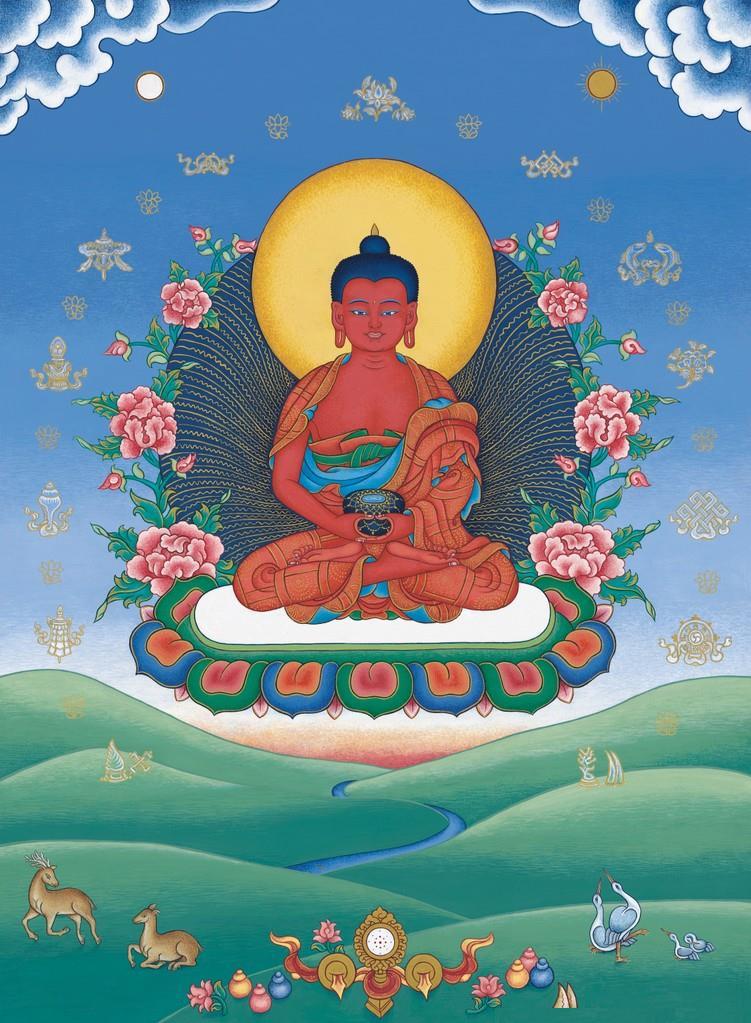
of the long-life deities such as Amitabha are commonly used. Deities
can be in peaceful or wrathful aspects. The wrathful ones are often
used to cure heavy disease such as AIDS.
If
you are not comfortable with these images, you can use other objects
such as crystals, or simply visualise all the universal healing
energy absorbing into you, transforming your body into light, and
imagine yourself as totally healed.
Over
the centuries many people have used these methods and have recovered
from their illnesses, even from conditions such as leprosy, paralysis
and cancer. The aim of these practises is to heal the mind as well
as the body, so that the diseases or problems will not recur in
the future.
Also,
many diseases are associated with spirit harm. Lamas and other practitioners
will often recite certain prayers and mantras or engage in ceremonies
to stop the spirit harm and allow the person to recover.
A
seven year old girl I knew had petit-mal epilepsy as the result
of spirit harm; the epilepsy disappeared after various rituals and
prayers had been performed. Whenever she had an epileptic attack,
the girl would see a frightening apparition coming towards her.
After the initial prayers had been performed, however, her attacks
lessened and she would see a brick wall between her and the frightening
figure. This wall was the colour of a monk's robes. Eventually the
attacks and visions disappeared altogether.
In
summary, we can say that the essential ingredients in the healing
process, for both the person doing the healing and the person being
healed, are compassion, faith, and pure morality.
Changing
our minds
Another
powerful method of healing in Tibetan Buddhism is to meditate on
the teachings known as thought transformation. These methods allow
a person to see the problem or sickness as something positive rather
than negative. A problem is only a problem if we label it a problem.
If we look at a problem differently, we can see it as an opportunity
to grow or to practice, and regard it as something positive. We
can think that having this problem now ripens our previous karma,
which does not then have to be experienced in the future.
If
someone gets angry at us, we can choose to be angry in return or
to be thankful to them for giving us the chance to practice patience
and purify this particular karma. It takes a lot of practice to
master these methods, but it can be done.
It
is our concepts which often bring the greatest suffering and fear.
For example, due to a set of signs and symptoms, the doctor gives
the label 'AIDS' or 'cancer'. This can cause great distress in a
person's mind, because they forget that it is only a label, that
there is no truly existent, permanent AIDS or cancer. 'Death' is
another label that can generate a lot of fear. But in reality 'death'
is only a label for what happens when the consciousness separates
from the body, and there is no real death from its own side. This
also relates to our concept of 'I' and of all other phenomena. They
are all just labels and have no true, independent existence.
Lama
Zopa Rinpoche, a highly realised Tibetan Lama, says that the most
powerful healing methods of all are those based on compassion, the
wish to free other beings from their suffering. The compassionate
mind - calm, peaceful, joyful and stress-free - is the ideal mental
environment for healing. A mind of compassion stops our being totally
wrapped up in our own suffering situations. By reaching out to others
we become aware of not just my pain but the pain (that is, the pain
of all beings).
Many
people find the following technique powerful and effective: think
"By me experiencing this disease or pain or problem, may all
the other beings in the world be free of this disease, pain or problem"
or "I am experiencing this pain/sickness/problem on behalf
of all living beings."
One
voluntarily takes on suffering in order for others to be free of
it. This is similar to the Christian concept of regarding one's
suffering as sharing the suffering of Jesus on the cross. Even death
can be used in this way: "By me experiencing death, may all
other beings be freed from the fears and difficulties of the death
process."
We
have to ask ourselves "What is the purpose of my life? Why
do I want to have good health and a long life?". The ultimate
purpose of our life is to be of benefit to others. If we live longer
and just create more negative karma, it is a waste of time.
Giving
and taking is another powerful meditation. As you breathe in, visualise
taking the suffering and the causes of suffering from all living
beings, in the form of black smoke. When breathing in the black
smoke, visualise smashing the black rock of selfishness at your
heart, allowing compassion to manifest freely. As you breathe out,
visualise breathing out white light that brings them happiness,
enjoyment and wisdom.
Developing
compassion is more important than having friends, wealth, education.
Why? Because it is only compassion that guarantees a happy and peaceful
mind, and it is the best thing to help us at the time of death
We
can use our sickness and problems in a very powerful way for spiritual
growth, resulting in the development of compassion and wisdom. The
highest development of these qualities is the full realisation of
our potential, the state of full enlightenment. Enlightenment brings
great benefit to ourselves and allows us to work extensively for
others. This is the state of ultimate healing.
I
have outlined some of the concepts that are the basis of the Buddhist
philosophy on healing. Many of these methods were taught by Lama
Zopa Rinpoche at Tara Institute in Melbourne in August 1991 during
the first course given by Lama Zopa specifically for people with
life-threatening illnesses.
Some
of these ideas may appear unusual at first, but please keep an open
mind about them. If some of the ideas appear useful to you, please
use them; if not, leave them aside.
May
you achieve health and happiness.
(revised
January 1995)
REFERENCES
Levine,
Steven Healing Into Life and Death, Anchor Press/Doubleday,
New York, 1987
Geshe Rabten and Geshe Dhargyey Advice From a Spiritual Friend,
Wisdom Publications, Boston, 1986
Sogyal Rinpoche The Tibetan Book of Living and Dying, Rider,
London, 1992
Lama Zopa Rinpoche Transforming Problems Into Happiness,
Wisdom Publications, Boston 1993
Lama Thubten Zopa Rinpoche The Door to Satisfaction, Wisdom
Publications, Boston, 1994
|
10 Malas a Day...
...keep the lower realms away!
One simple way to be constantly benefiting animals is to do
mantras to purify your body so that wherever you go, beings in your
vicinity are blessed:
“..when a person who has recited ten malas of Om Mani
Padme Hum a day goes into a river or an ocean, the water that touches
that person’s body gets blessed, and this blessed water purifies all the
billions and billions of sentient beings in the water. So it’s
unbelievably beneficial.”
What is animal liberation?
Animal
liberation in the Buddhist tradition is a practice to save an animal
from impending death, such as an animal soon to be killed for human
consumption, and doing prayers and practices to help that being. It is
also a practice that benefits those who do the liberating. It brings
them much merit (good karma) and it can be helpful in removing life
obstacles due to such things as serious illness. It is also a way to
generate compassion. 
What animals
need is a get-out-of-jail card not just for this life, but also for the
lower realms and ultimately from cyclic existence altogether. The Buddha
explained how difficult
it is to get out of the lower realms, where beings continually create
more negative karma and the causes for more and more animal and lower
realm rebirths. To really help our animal brothers and sisters, we need
to help them create the causes for higher rebirth and enlightenment.
It is also
very important to ensure that the animals have the best possible care
after they have been ‘saved’ from death. Good animal liberation practice
combines compassion (the wish to free beings from suffering) with
wisdom (a recognition of cause and effect and the interconnectedness of
things). Releasing animals where they will immediately be under threat
is not ideal, nor is releasing animals where they will cause harm to
others, such as animals from a different ecological niche that become an
environmental problem. It is therefore an important part of the animal
liberation practice to look carefully at the suitability of liberating
animals in your area.
Reduce Consumption - Go Veg
Billions of
animals are harmed and killed every year at the hands of humans. Most of
this is to produce meat for food. Clearly one of the simplest ways to
reduce this is to reduce your own consumption.
Whether you go
vegan, vegetarian, or make a commitment to minimise what animal products
you use, this has an effect in a market economy. It may not appear to
make much difference over a day or a week, but each month, each year,
you follow this practice, you are influencing the economy and saving
lives.
Each time you
don't buy meat, this becomes a statistic and whether it is the small
take-away business owner, the supermarket chain number cruncher, or the
farmer, it is registered and they respond inevitably to the market
change.
DID YOU KNOW….
- It takes about 50,000 litres of water (11,000 gallons) of water to produce 1 kilo (2.2 pounds) of meat?
- Animals raised
for food produce approximately 130 times as much excrement as the
entire human population – that’s about 40,000 kilograms (88, 183
pounds) per second!
- Producing one
kilo of beef, produces 52 kilograms (114.6 pounds0 of carbon
dioxide whereas producing one kilo of wheat produces less than one
kilo of carbon dioxide
- The world’s cattle consume enough to feed 8.7 billion people – more than the entire human population
 Eating for Climate Change
Climate
change is a frequently discussed topic. What few people realise is that
meat eating is also a major contributor to climate change. A United
Nations report [1] co-ordinated by the UN’s Food & Agriculture
Organisation found that “the livestock sector is a major player,
responsible for 18 percent of greenhouse gas emissions measured in CO2 equivalent. This is a higher share than transport”.
The
report stresses that “the livestock sector emerges as one of the top
two or three most significant contributors to the most serious
environmental problems, at every scale from local to global. The
findings of this report suggest that it should be a major policy focus
when dealing with problems of land degradation, climate change and air
pollution, water shortage and water pollution, and loss of
biodiversity.” The report goes on further to say that “the impact is so
significant that it needs to be addressed with urgency”.
The
cruelty inflicted on animals so that animal products can be brought to
our plates is becoming increasingly well known. The environmental costs
are also mounting. For example: nitrous oxide is about 300 times more
potent as a global warming gas than carbon dioxide. The meat, egg, and
dairy industries account for an incredible 65 percent of worldwide
nitrous oxide emissions.
When
looking at statistics it is important not to lose sight of the
individual. Who and what are the beings that make up the ‘livestock
sector’?
Those
who have pets or have observed farm animals cannot disagree with the
fact that animals have individual personalities and have very similar
responses to humans to external stimuli – the cat who doesn’t want to
get her paws wet on the dewy lawn, the cow who rubs an itch with such
satisfaction, the chicken who runs to the feed bucket with eager
anticipation. Just instinct, or are these the signs of our fellow
earthlings on their very own pursuit of happiness?

The
UN report warns that “the environmental impact per unit of livestock
production must be cut by half, just to avoid increasing the level of
damage beyond its present level”. If we each reduced our consumption of
animal products by a half we would not only reduce the suffering of
animals, not only reduce global warming and environmental degradation,
we would also reduce our grocery costs and give a boost to our health.
As the Buddha said: “Happiness is never diminished by being shared”. Giving Dharma Names to Animals
Most people give their pet animals names they
think are cute or sound cool or perhaps reflect the animals’
personality. As Buddhists, we are missing a huge opportunity if we do
this and doing our animals a disservice. As Lama Zopa Rinpoche says:
“If you have a pet it is very good to give it a Dharma name rather
than giving it a useless name that has no benefit for the animal. If
you give your pet a Dharma name, such as names of the path to
enlightenment (renunciation, bodhicitta, emptiness – they can be in
English, Tibetan or Sanskrit) it leaves a positive imprint on the mind
of the animal.”
Rinpoche explains by giving an example of his dog at Aptos:
“So we called the dog in Kachoe Dechen Ling ‘Om mani padme hung’.
Each time she hears her name it plants the seed for the whole path to
enlightenment, it leaves a positive imprint on her mind. Also, it
creates the cause for her to understand all the 84,000 teachings of
Buddha because they are contained in om mani padme hung: the two truths,
the path of method and wisdom and the goal, dharmakaya and rupakaya.
Each time we call her name it leaves a positive imprint for her to be
able to hear the whole sutra and tantra, the complete extensive
teachings of Buddha. This is incredible; definitely each time she hears
her name it brings her closer to enlightenment. This is such an easy way
to benefit animals and to bring them closer to enlightenment so we must
do it, we must attempt every single way to benefit them. We must do it
for others, to quickly liberate them from samsara, which is only in the
nature of suffering and which has no beginning, which is continuous.

Understanding the incredible benefits just of naming your pets, it is
very silly and foolish if you don’t do even this. It’s such an easy way
to benefit them, even if you don’t do bigger things like building a
stupa to benefit the sentient beings living with you. What you can
easily do is take them around holy objects, chant mantras, read lam rim
prayers that contain the whole path, the Heart Sutra, Diamond Cutter
Sutra, Sutra of Golden Light, Arya Sangatasutra, and chant powerful
mantras as much as possible. There are so many practices you can recite
next to them as well as many other things you can do, but if you can’t
do these then an easy one is giving them a Dharma name that will benefit
them very much.
During Choden Rinpoche’s teachings at Vajrapani a few years ago
Rinpoche said that Lama Atisha called animals ‘sangpo’, which means
“good-hearted.” Probably he is not saying: I am good-hearted, but as
Lama Atisha has bodhichitta maybe he is saying that his bodhichitta came
from them. Lama Atisha gave teachings to numberless sentient beings,
liberating them from the oceans of samsaric suffering and bringing them
to enlightenment. As all this was received from these animals, from
their kind heart, the reason Lama Atisha calls them sangpo is that he is
naming the result on the cause. Sometimes he may have called them
triche, which means “kind one.” This is maybe to benefit one’s own mind,
referring to all animals as “kind one”, remembering how all one’s
happiness comes from them.
Suggested Dharma Names
Below
are some examples of beneficial names you can give your pets (or
children!). We have listed only single word names rather than double as
single words are easier when calling for your pet. But you can combine
some of the words as Tibetans do, for example: Samten Chodron (female)
means 'Truth Light of Meditation' or Jinpa Phuntsok (male) means
'Generous One Full of Qualities'.
|
NAME
|
MEANING
|
|
Acharya
|
A spiritual master
|
|
|
|
|
|
|
|
Amrita
|
Nectar of the gods
|
|
Arya
|
A being who has attained a direct realisation of the true nature of reality.
|
|
Asanga
|
4th
century Indian scholar; One of then two most important masters in the
development of the Mahayana Buddhist schools of ancient India.
|
|
Atisha
|
11th
century Indian scholar accredited with founding of the Tibetan
Mahayana school called Kadam. His works include the great text ‘Lamp
of the Path of Enlightenment’
|
|
Bodhicitta
|
Awakened mind, mind of enlightenment
|
|
Bodhi
|
Enlightenment
|
|
Chodak
|
Dharma Spreader
|
|
Choden
|
One who is devout, religious
|
|
Choedron
|
Truth Light
|
|
Choegyal
|
Dharma king
|
|
Chokyi
|
Joyful Dharma or teachings
|
|
Chophel
|
The flourishing of the Dharma
|
|
Dagpa
|
Pure
|
|
Dana
|
(Sanscrit) voluntary giving of material, eneregy, or wisdom to others; one of the 6 Perfections
|
|
Dechen
|
Great Bliss
|
|
Deyki
|
Happiness and Joy
|
|
Dhargey
|
Progress, development, spreading
|
|
Dharmata
|
Suchness,
true nature of things; phenomena as it really is,as seen by a
completely enlightened being without any distortion,
|
|
Dondrub
|
Accomplishment, attainment, realizer
|
|
Dorje
|
Vajra, which means indestructible
|
|
Drimed
|
Stainless, imaaculate, undefiled
|
|
Drolma
|
Liberator Tara
|
|
Drolkar
|
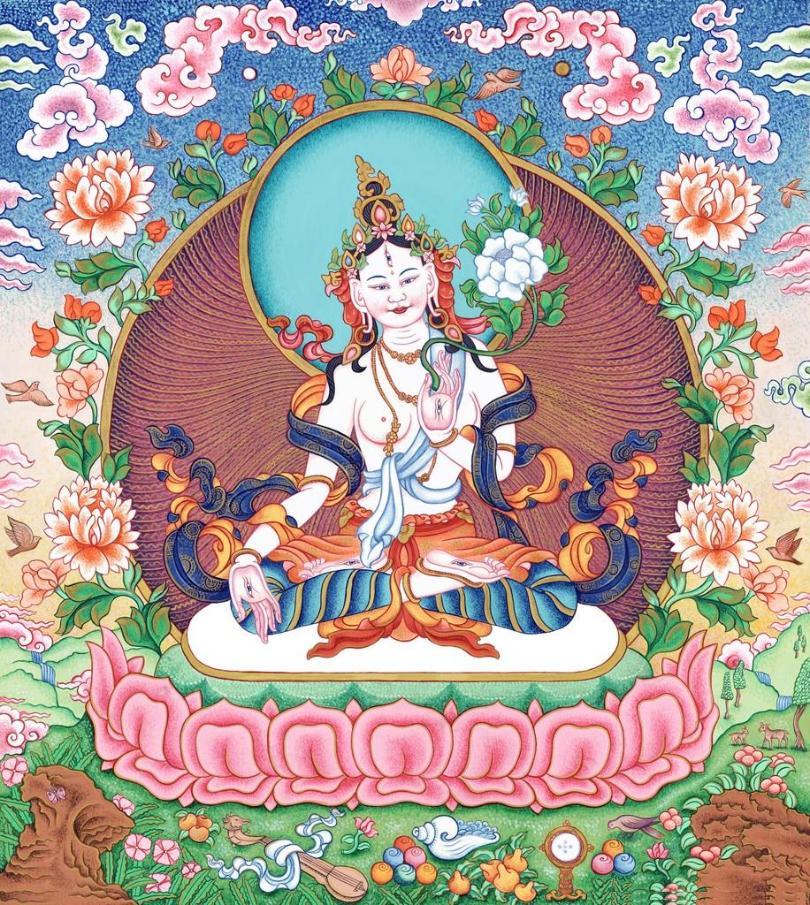
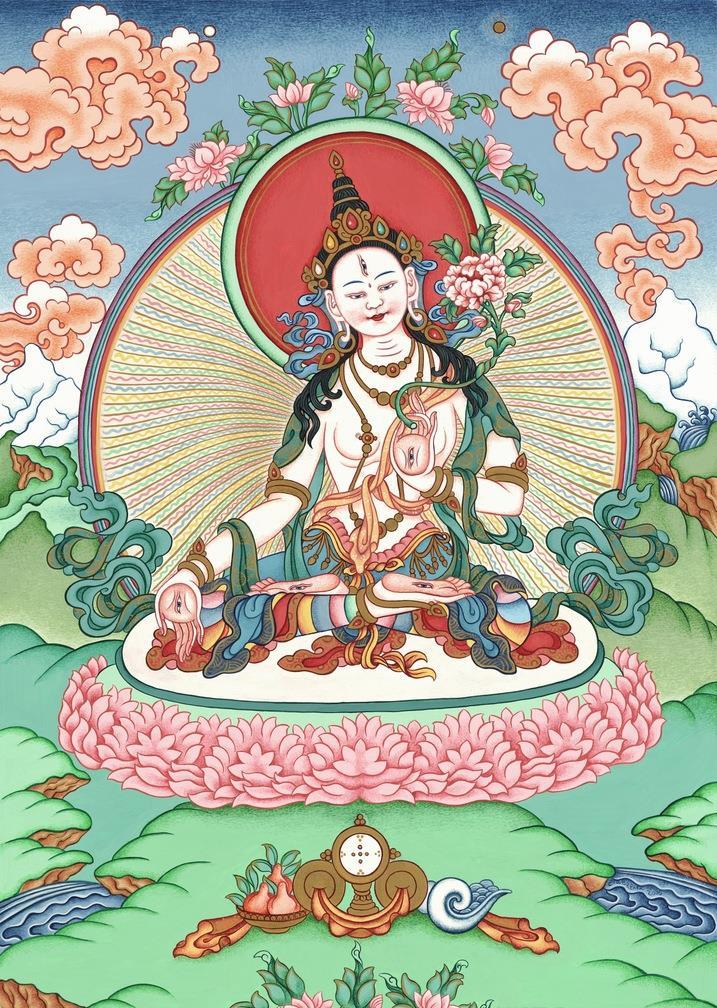
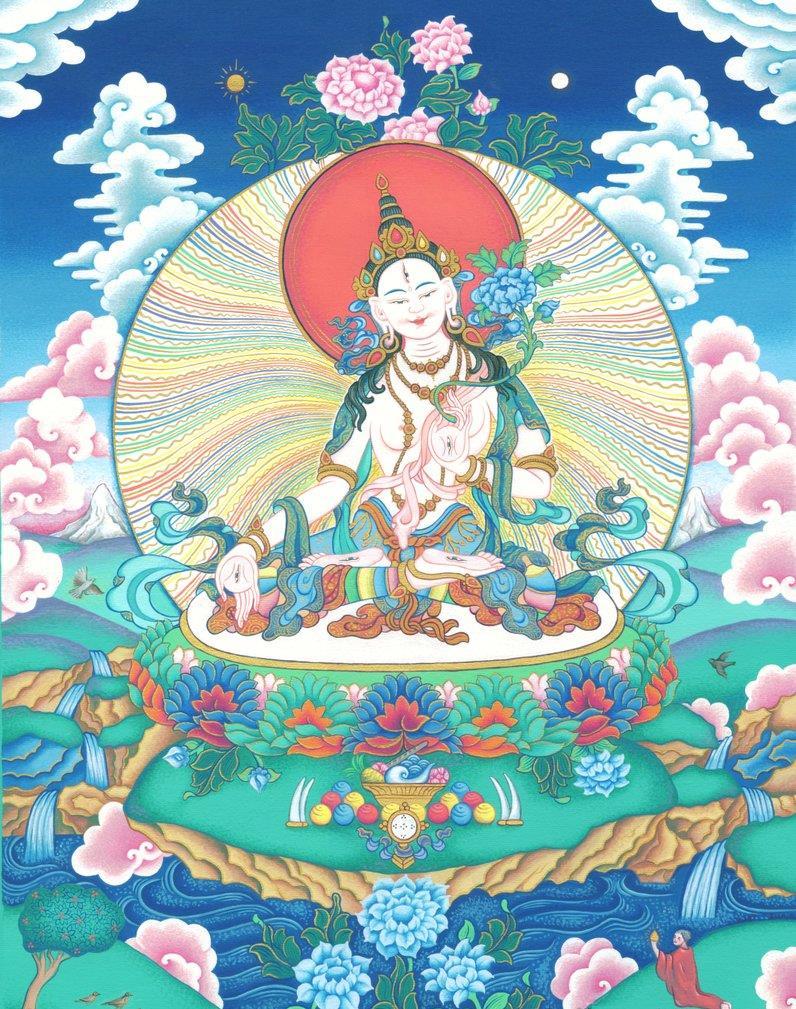
White Liberator Tara (long life deity)
|
|
Gendun
|
Helper
|
|
Gyaltsen
|
Victory banner
|
|
Jampa
|
(Maitreya, the next Buddha) Loving-kindness
|
|
Jamyang
|
Gentle voice (Manjushri)
|
|
Jangchub
|
Enlightenment
|
|
Jigme
|
Fearless
|
|
Jinpa
|
Generosity
|
|
Kalden
|
Good fortune
|
|
Kalsang/Kelsang
|
Fortunate, Good fortune
|
|
Karuna
|
Compassion
|
|
Karma
|
Action, deed
|
|
Kaya
|
Body of a Buddha
|
|
Khandro
|
Dakini
|
|
Kunchen
|
All-knowing
|
|
Lekshey
|
Right speech. eloquent
|
|
Lhakyi
|
Happiness, joy
|
|
Lhundup
|
Spontaneously accomplished
|
|
Lobsang
|
Kind One, Noble-minded, kind-hearted,
|
|
Lodro
|
Wise One, intelligent
|
|
Lungtok
|
The Teachings, scriptures
|
|
|
|
|
|
Ngawang
|
Powerful speech
|
|
Ngedon
|
Ultimate truth
|
|
Ngodup
|
Attainment, accomplishment
|
|
Norbu
|
Jewel
|
|
Nying jye
|
Compassion
|
|
Osel
|
Luminosity, luminous clarity
|
|
Palden
|
Glorious
|
|
Paramita
|
Perfect virtues, the perfections
|
|
Pelkyi (female)
|
Radiant Happiness
|
|
Pema
|
Lotus
|
|
Phuntsok
|
Excellence (excellent qualities, most perfect qualities)
|
|
Prajna
|
Wisdom, discriminative awareness
|
|
Rabten
|
Steadfast
|
|
Rigpa
|
Awareness of the absolute
|
|
Rigzin
|
Wise One, Knower; wisdom
|
|
Rinchen
|
Precious, gem, treasure (great value)
|
|
Samadhi
|
Concentration, meditative stabilisation
|
|
Samdup
|
Fulfillment (of one's wishes)
|
|
Samten (male)
|
Samadhi, Perfect stability in meditation
|
|
Sang
|
Purified, awakened
|
|
Sangpo
|
Good hearted
|
|
Sangye
|
Buddha
|
|
Sempa
|
Bodhisattva
|
|
Shamatha
|
Calm abiding
|
|
Shedrub (male)
|
Accomplisher of highest knowledge
|
|
Shepa
|
Awareness, knowledge
|
|
Sherab
|
Perfect knowledge, Wisdom, discriminative awareness
|
|
Shunyata
|
Emptiness
|
|
Sila
|
Moral discipline
|
|
Sonam
|
Merit
|
|
|
|
Tenpa
|
(holder of the) Teachings
|
|
Tenzin
|
Holder of the teachings
|
|
Thekchen
|
Mahayana
|
|
Thokmay
|
Unobstructed, unhindered
|
|
Thubpa
|
Capable or Mighty One
|
|
Thubten
|
The Buddha's teaching
|
|
Tinley/Trinley
|
Enlightened activity
|
|
Tilopa
|
One of the 84 mahasiddhas of ancient India and the guru of the great scholar and meditator Naropa.
|
|
Tsering
|
Long life
|
|
Tseten
|
Stable life
|
|
Tsewang
|
Life empowerment
|
|
Tsognyi
|
The two accumulations: merit and wisdom
|
|
Tsondru
|
Diligent One
|
|
Tsultrim
|
Moral discipline
|
|
Tushita
|
Pure Land of joy
|
|
Tutob
|
Great Abilities
|
|
|
|
Wangchuk
|
Lord, mighty
|
|
Wangdue
|
Subduer
|
|
Yangchen (female)
|
Melodious One
|
|
Yangkyi (female)
|
Inspired Happiness
|
|
Yangzom (female)
|
Perfect Woman of Accomplished Qualities
|
|
|
|
Yeshe
|
Deep/pristine awareness, widsom knowledge
|
|
Yodron (female)
|
Turquoise Light
|
|
Yonten
|
Good qualities
|
|
Zopa
|
Forbearance, patience |
Animal Facts
“Today,
together with a growing appreciation of the importance of human rights
there is a greater awareness worldwide of the need for the protection
not only of the environment, but also of animals and their rights. Where
there is a mind, there are feelings such as pain, pleasure and joy. No
sentient being wants pain, instead all want happiness. Since we all
share these feelings at some basic level, we as rational human beings
have an obligation to contribute in whatever way we can to the happiness
of other species and try our best to relieve their fears and
sufferings”.

From
a Buddhist perspective, all animals are considered sentient beings and
have minds and ‘Buddha nature’, which is the seed of Enlightenment.
Those who have pets or have observed farm animals cannot disagree with
the fact that animals have individual personalities and have very
similar responses to humans to external stimuli – the cat who doesn’t
want to get her paws wet on the dewy lawn, the cow who rubs an itch with
such satisfaction, the chicken who runs to the feed bucket with eager
anticipation. Just instinct, or are these the signs of our fellow
earthlings on their very own pursuit of happiness? Below are some
examples that demonstrate how easy it is to dismiss animals as lesser
beings simply because we do not understand their language.
Which
animal understands sophisticated intellectual concepts, learns from
watching others, and has cultural knowledge passed from generation to
generation? Primates certainly do, but here we are talking about
chickens . What about this one: curious and insightful, friendly,
loyal and affectionate, thought to have intelligence beyond that of an
average 3-year-old human child. Did you guess pigs? Dr. Donald Broom,
scientific advisor to the British government says that pigs “have the
cognitive ability to be quite sophisticated. Even more so than dogs and
certainly three-year-olds.”
Another
one: very loyal to their families and very protective of their partners
and offspring, often refusing to leave an injured or sick mate or young
behind. Answer – geese. After a partner dies, some geese spend the rest
of their lives without a mate, which can be up to 25 years! This one
might surprise you: sensitive, with their own individual personality,
excellent memories and able to avoid harm by watching and copying others
in their group, some ‘eavesdrop’ to get information, and some use
tools. Fish. Marine biologist Dr. Sylvia Earle says, “they’re so
good-natured, so curious. You know, fish are sensitive, they have
personalities, they hurt when they're wounded.” And we haven’t even
mentioned cows, who are described as intelligent, loyal animals who
enjoy solving problems. Animal experiments
Many people are
unaware that some cosmetics, foods and beverages, household products,
personal care products, and medicines are tested on animals even though
tests using animals are often unreliable or not applicable to humans.
Nor do most people realise that animals are often tormented in
experiments in universities or hospitals or in military training
exercises.
The practice of experimenting on animals, or vivisection, has been around since ancient times. By the 19th
century it was well established and as a result, in 1876, due to public
outcry and the work of a few dedicated compassionate people the
British Parliament passed the first anti-vivisection law, the Cruelty
to Animals Act.
Unfortunately,
the cruel practice of vivisection continues around the world with the
British Union Against Vivisection estimating that worldwide on average
115 million animals are used and/or killed in the name of science every
year. The United States is the largest animal testing country with over
100 million animals used annually in biological and medical research
to study human disease, injury, development, psychology, and anatomy
and physiology. Meanwhile, in 2009, the UK carried out over 3.6 million
such tests (see http://rds.homeoffice.gov.uk/rds/pdfs10/spanimals09.pdf).
Europe as a whole used 12.1 million animals in 2005 (the latest
figures available) with the UK, France, and Germany being the biggest
users.
The most
commonly used animals are mice, rats, guinea pigs, rabbits, dogs, cats,
and primates. Animals often suffer terribly in these studies. In an
attempt to mimic human conditions, they are inflicted with diseases,
traumas, and pain they would not normally experience.
“Monkeys are
addicted to drugs and have holes drilled into their skulls, sheep and
pigs have their skin burned off and rats have their spinal cords
crushed. Tiny mice grow tumors as large as their own bodies, kittens are
purposely blinded, and rats are made to suffer seizures. In
archaic medical training courses, pigs and dogs are cut open and
killed and cats and ferrets have hard plastic tubes forced down their
delicate throats.” (www.peta.org)
The supplying of
animals for research has created and entire industry which treats
animals as tools rather than as thinking, feeling, sentient beings.
Animals are intentionally bred for research or bought from auctions,
pounds, shelters, ‘free to good home’ ads, or other random sources.
Commonly used tests include:
Toxicity Tests
– in which animals are force fed substances until a predetermined
percentage of them die. The symptoms of poisoning that the animals
experience include diarrhoea, paralysis, convulsions and internal
bleeding. At the end of the tests, all animals are killed.
Draize Eye Test
– fully conscious animals are restrained whilst concentrated substances
are applied to their eyes. Animals experience terrible, long-lasting
pain with swelling, discharge, blistering and destruction of the cornea.
Draize Patch Test
– unanaesthetised animals are immobilised in restraint devices. Their
skin is then shaved until raw and the test product is applied. Resulting
reactions include severe burns.
As well as being
cruel, animal experiments hold very little scientific value. They not
only hurt animals and waste money, but they can harm people by their
unreliability. They are inhumane, outdated and often
produce misleading results. Fortunately, alternatives to to the use of
animals is growing every day. However, due to conservatism in the
scientific establishment and bureaucratic hurdles, change is a slow
process.
But you can help
by encouraging your regulatory bodies to invest in alternatives to
animal experiments, by letting your government know that you do not
support the use of animals in experiments, and as a consumer, only
purchasing products that are not tested on animals and by supporting
humane charities.
PLEASE Be a
compassionate consumer !!!. Vow to only buy products from companies that do
not use animals and remember to ask when charities are asking for your
donation, whether they spend their money on horrific experiments. Pet Stores
Thinking
of getting a furry companion? Rather than being lured by the carefully
marketed cute ‘display items’ in pet shops, resist the temptation in the
window and rescue an animal from the pound or local shelter. Pet shops
generally get their puppies and kittens from backyard breeders and
“puppy farms”, where animals are often raised in cramped, crude and
filthy conditions and where veterinary care and socialisation is
lacking. Because consumers continue to buy these animals from pet shops,
this cruel and irresponsible breeding for profit continues. 
Meanwhile,
millions of homeless animals are killed in pounds. For example, in
Australia alone approximately 130,000 dogs and 60,000 cats are killed in
pounds every year! Soooo many lives! And think of the people who have
to do the killing.
If
everyone who wanted a pet adopted from a pound or shelter rather than
buy one at a pet shop or market, these deaths would be drastically
reduced. You would be saving a life and saving a person in a pound from
killing.
So
next time you or someone you know is looking for an animal companion,
think of the animals about to die in the pound and save a life instead.
To learn more about fostering, go to our Foster an Animal page.
Some useful websites to find out more information about pet stores: http://www.peta.org/issues/companion-animals/pet-shops.aspx http://www.saynotoanimalsinpetshops.com/
Eating with Compassion
Every day we make choices on what we eat without considering the
suffering that makes up our food. By adopting a vegetarian, or even
better vegan, lifestyle we can reduce this suffering. Billions of
animals are killed around the world every year so that people can eat
their flesh. For example, over 9 billion chickens are killed annually in
the US alone. 
We can make an active choice to lessen our contribution to the
killing (and therefore lessen the karma of killing accumulated by
others).
Even though we are not directly doing the killing, we are still contributing to these deaths. According to the Lankavatara Sutra the Buddha said:
"It
is not true, Mahamata, that meat is proper food and is permissable for
the Sravaka when [the victim] was not killed by himself, when he did not
order others to kill it, when it was not specially meant for him."
The Buddha gave thousands of teachings and some teachings were given
in different ways to different audiences, depending on their
disposition. The Lankavatara Sutra
devotes an entire chapter (Chapter 8) to the avoidance of eating meat.
This sutra, and others like it, is a Mahayana teaching directed to those
disciples who have affirmed a wish to develop great compassion and
bring all beings to enlightenment.
"For
innumerable reasons, Mahamati, the Bodhisattva, whose nature is
compassion, is not to eat any meat...Thus, Mahamati, wherever there is
the evolution of living beings, let people cherish the thought of
kinship with them, and, thinking that all beings are [to be loved as if
they were] an only child, let them refrain from eating meat. So with
Bodhisattvas whose nature is compassion, [the eating of] meat is to be
avoided by him. Even in exceptional cases, it is not [compassionate] of a
Bodhisattva of good standing to eat meat."
 Live chickens on motorbike
For more information about the benefits of vegetarianism and how to do it, visit the following website GOVEG.
 |
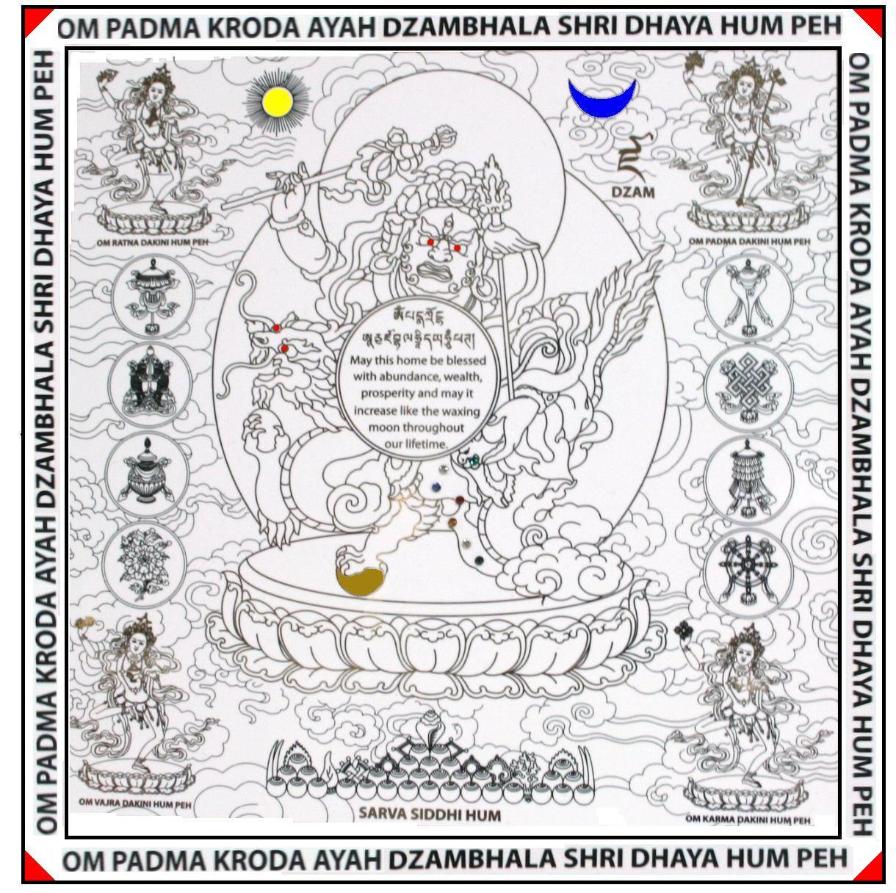
Powerful Practice For Wealth - Water Ritual of the White Dzambhala
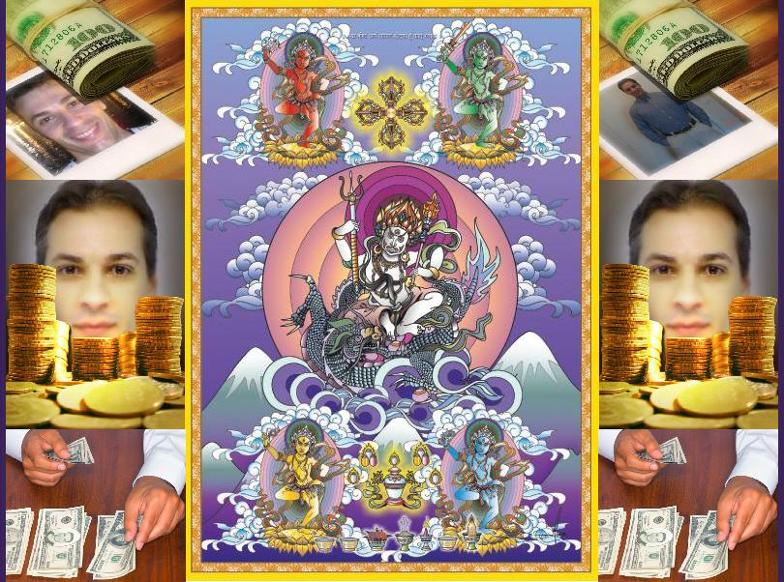
There is a powerful Buddhist ritual that addresses the popular
aspiration to get rich. The practice involves offering a light stream of
water over the head of the Dzambhala symbolized by its image. The White Dzambhala
is a wealth granting aspect of the Compassionate Buddha and in this
form sits on a turquoise dragon, surrounded by four dakinis each
signifying a Buddhist cosmic family and a compass direction. Dakinis are
powerful female angels who help Dzambhala bring riches into the lives
of those who do the water ritual daily while reciting their mantras. FSW
is very happy to share this practice with readers. It is
important to generate an altruistic intention when doing this practice.
When your desire to become rich is only to benefit yourself, it deprives
the practice of much power. When your aspiration is fueled by your
great desire to help others however, the ritual takes on much added
power. Even when your motivation is inspired by your great wish to
benefit your loved ones, this is far better than just thinking of
yourself. Thus for those needing the money to fund their
children’s education, to buy a house for the family, to pay for hospital
bills for instance… and you think through these needs of yours before
doing the ritual then, it will establish a good and pure motivation that
really adds great strength to the practice. The PreparationsFirstly,
get an image of the White Dzambhala. Commit the image of Dzambhala to
memory. Notice that White Dzambhala is sitting on a turquoise dragon and
is carrying a white trident in one hand and a banner in another. Secondly,
get images of the four Dakinis. These are beautiful offering Goddesses
from the four Buddhist families, each of whom live in a different
direction. From the East comes blue coloured Vajra Dakini who holds a thunderbolt in her right hand; from the South comes Ratna Dakini who holds a jewel in her right hand; from the West comes Padma Dakini and she holds a lotus in her right hand; and from the North comes green coloured Karma Dakini
who holds a sword in her right hand. Commit the images of the dakinis
to memory to aid you in your visualizations as you recite their mantra. Thirdly
set up your crystal bowl in which you place an inverted glass to place a
flat surface on which you place White Dzambhala in the center
surrounded by the four dakinis. Finally prepare
a jug of fresh water filled to the brim; it should have a thin spout
from which you will pour water over White Dzambhala’s crown as you
recite his mantra. Do this pouring slowly and with great loving
gentleness. Mantra PracticeBegin by generating a good motivation… then start reciting the mantra of White Dzambhala:
Om Padma Krodha Arya
Dzambhala Hridaya Hum Phat
|
As you recite, start offering the water on the head of Dzambhala.
Do this slowly but steadily and note that it should be a fine stream of
water. As you pour the water with your right hand, snap the fingers of
your left hand in front of your heart and recite the mantra a minimum of
seven times and preferably 108 times. If you have a rosary of 108 mala
beads, use this and make it your designated mala for doing this
practice. At times when you are in a rush, you can recite 21 or 28
times. The Visualisation As
you recite the Dzambhala mantra and pour the water on his head, think
that from the mouth of the Dragon and from the mouth of Dzambhala’s
mongoose come an unceasing flow of wish-fulfilling jewels and dollar
notes, millions and millions of dollars. The flow of wealth comes like
beautiful water falling down from the mountains. Think that Dzambhala is
experiencing great bliss from the water so he promises to help you by
bringing big wealth for your family and your business. The Four Dakinis Next
you must turn your attention to the four dakinis. If there is any water
left, you can also pour over the heads of the dakini images. If not,
then all you need to do is to recite the mantras of the four dakinis as
follows. Recite 21 sets of these mantras.
Om Vajra dakini hum phat
Om Ratna dakini hum phat
Om Padma dakini hum phat
Om Karma dakini hum phat
Sarwa Siddhi hum |
 Dedications DedicationsWhen
you have finished reciting all the mantras, it is important to dedicate
the practice and the ritual just performed to your family and to the
success of all your financial aspirations. The water used for the ritual
can be used to make tea or to pour over plants or into your fish tanks
or water features… You can also place a White Dzambhala
image under the falling water in this nine level waterfall. Place this
in the North, East or Southeast of your living area… and keep the water
flowing through the day. You can turn off the waterfall in the night. If
you have such a waterfall in the house, it is also a good idea to
recite the mantra 21 times in front of the waterfall, as this creates
the great merit of invoking Dzambhala’s assistance for the family or the
business. You can also create this water feature in your office.
Everything You See Has A Meaning
 Interpreting Signs, Dreams & Flames to make divinations. Interpreting Signs, Dreams & Flames to make divinations.
The
Tibetans are very sensitive to receiving predictive messages from
divine beings that over the centuries they have fine-tuned their cosmic
antenna to such an extent that they are open to the idea of receiving
coded messages from the Cosmic Universe that indicate good or bad
outcomes to problems troubling them. Indeed, they even interpret simple
things like the shape of flames in candle lamps as providing answers to
pressing questions. Signs and symbols are revealed in things they see as
they set out on a journey or observed through cloud formations – these
and much more serve as Oracles from the Cosmos. Lillian Too shares some
personal revelations picked up through the course of her friendships
with Tibetan lamas and monks.
Tibetans assign positive or
negative meanings to all the things they encounter along a walk or when
they start a journey and even on a casual car ride. What will suddenly
piqué their interest is anything unusual or out of the ordinary –
something they do not see every day. As one revered old monk once
explained, “When we see something that we do not usually see, it can
have a predictive meaning such as a warning of some kind or an
indication of an unexpected manifestation of good luck.”
Reading
signals from everyday occurrences is something ingrained within their
psyche, and considering how superstitious they can be, Tibetans
generally regard signs as coded messages that suggest either good
fortune is around the corner or some unhappy event is about to occur.
Positive
indications include seeing cranes, geese, ducks, swans, pheasants and
other auspicious birds flying overhead or hearing their calls; seeing
auspicious images in cloud formations; overhearing the sounds of drums,
stringed instruments, flutes, gongs, bells; people reciting auspicious
stanzas including such words as victorious, accomplished, excellent,
happiness, success, give it, take it, fruitful, great, numerous and
glorious.
My good friend, a monk from Sera Je monastery told me
that these days, if you should turn on the TV and the first words you
hear are positive or if you are tuned into a news channel and what is
being reported is good news, then it is a good sign. If the news is
bleak or is warning about some impending disaster, then you should be
extra careful.
 This
has somehow stuck in my mind which is probably why I always turn to
either the DISCOVERY channel or to the DISNEY channel before I turn it
off. This ensures that each time I turn on again, I do not inadvertently
catch some bad news. I also never watch horror, crime, disaster or
violent movies. I believe that having imprints of any kind of negative
images stamped into my consciousness is sure to disturb my mind,
creating then the cause for negative things to happen. This
has somehow stuck in my mind which is probably why I always turn to
either the DISCOVERY channel or to the DISNEY channel before I turn it
off. This ensures that each time I turn on again, I do not inadvertently
catch some bad news. I also never watch horror, crime, disaster or
violent movies. I believe that having imprints of any kind of negative
images stamped into my consciousness is sure to disturb my mind,
creating then the cause for negative things to happen.
Look at
this list of negative things that foretell some misfortune happening.
These indicate obstacles of some kind that bring suffering or
unhappiness.
Negative signs include encountering any kind of
obstacle that blocks your journey. This can be a police road block, a
fallen tree across the road, or road works that cause you to have to
stop. Some even consider red traffic lights as indicating a minor
obstacle – especially if you are going to attend court or an important
meeting or job interview. On such occasions, everything negative that
you see on the road as you make your way to your destination can be mild
warning signs. Encountering a funeral or seeing people in mourning are
regarded as especially bad luck.
 MEANINGFUL DREAMS MEANINGFUL DREAMS
Tibetans
believe that strong signals from our inner consciousness can
communicate impending misfortune and good fortune. Many of you reading
this will have the gift of great insight, even without you knowing, and
these manifest as predictive dreams. Once you become aware of this
possibility and start to tune in consciously, you will begin to take
notice of your dreams.
Be alert to the possibility that you can
indeed be gifted with the ability of clairvoyant dreams, and if so, you
can start to consciously try to recall your dreams. In time, you can
even predict lucky events for yourself and your family. Remember we are
all psychic to some extent, but we need to consciously develop it. Tibetans all believe in their own capability to do so and are thus very aware of the meanings of the things they dream. Predictive
dreams usually take place just before you wake up at dawn, and such
dreams are usually very clear. Like other forms of natural inner
divination, they occur as the result of some special dilemma or problem
you are trying to deal with inside your head. The symbolism manifested
for you is usually easily understood by you yourself instinctively, and
you will indeed receive some kind of overall feeling of negative or
positive energy.
GOOD DREAMS Naturally,
the Tibetans believe that when you dream of any of the Buddhas,
Bodhisattvas, Deities or Protectors, it is an extremely excellent and
powerful sign. If you are receiving teachings or some kind of
empowerment, it is even more excellent, so this is definitely a cause
for rejoicing. In addition, if you dream of being given a high
chair, a bed or a big table, it is also extremely indicative of a very
fortunate promotion coming your way. Dreaming of being given a new suit
of clothes, of taking a bath, of being given a precious ornament with
either a religious or symbolic good fortune meaning is very auspicious. When
you dream of visiting temples, palaces or some other beautiful public
place, or if you are inside a templeaz and you encounter holy objects,
tigers, dragons, lions, birds, horses or elephants, these are all
indications of some high office coming to you. If you dream of
flying upwards to the sky getting close to the sun and moon, swimming
across the sea, seeing the sun or moon rising, eating dairy products
such as milk or yoghurt, sitting on a lotus, being respected and praised
by the gods, by parents, spiritual masters, beautiful ladies, and
friends, dreaming of eating or plucking ripe fruit, and meeting
important or wealthy people, meeting high gurus or virtuous masters and
seeing geese and other auspicious birds – these are all lucky dreams. | You
should be allergic to hearing words of defeat, death, sickness or
anything that suggests a negative outcome. When you hear words of defeat
suggesting that what you are about to embark on will be difficult,
unsuccessful or hopeless, you must instantly counter it with a strongly
positive statement. This acts as an antidote to the bad signal. At the
same time, also visualise a big cross drawn over the negative statement
or image in your mind. |
 GOOD OMENS GOOD OMENS
In
general, when starting a journey or beginning a new project or
business, good indications of success are suggested when you meet a well
groomed gentleman or lady. Well dressed men, women and children are
always good omens, even when you see them on television or on a sign
board, or better yet, as a real person.
This is one of the
reasons why I always encourage my friends to wake up earlier than their
husbands, then dress in something pretty, wear some jewellery and always
wear make-up. If the first thing a man sees when he wakes up is his
wife looking fresh and beautifully groomed, it brings incredibly
auspicious good luck to all his endeavors for the rest of the day! It is
surely not a coincidence that the emperors and kings of past eras were
always woken up by lovely maidens all groomed to perfection. In fact, it
is believed that seeing women dressed in white who are also beautiful
and bejeweled is an extremely auspicious sign.
Another sign of
good fortune is meeting a pregnant woman or even encountering pregnant
animals. The Tibetans believe that when a pregnant woman gives you money
or passes something she is wearing – a dress or a piece of jewellery –
to you, it is incredibly auspicious; more so if she happens to be
carrying twins because this means the good fortune is doubled!
When
you encounter anyone illustrious such as someone extremely successful,
rich or influential, it is also a good sign. This also applies if you
turn on the TV and see someone like Bill Gates for instance being
interviewed. Some of the positive energy of these people are said to
pass on to you. This is probably something we all know instinctively -
otherwise why are we so into the celebrity culture?
Another
positive indication of good fortune is seeing young children playing
happily together; seeing elephants; seeing smart looking carriages (cars
in our modern age), and people holding religious symbols such as the
wheel, vase, garland, lotus, umbrella, or banners in celebration. In
fact, when you encounter a religious celebration of any kind, it is
deemed to be extremely auspicious.
SIGNS OF FAILURE
Signs
of failure are events such as losing your luggage, encountering
beggars, seeing someone with torn clothes, having the road blocked,
seeing collapsed houses, encountering a fallen tree across the road,
witnessing something catching fire or spilling something or breaking a
cup or saucer while eating breakfast. Whenever things break down in your
home, it is a negative sign. Thus broken fuses, lights not working or
the plumbing bursting are all gentle warning signs that must be attended
to. |
 OVERCOMING OBSTACLES OVERCOMING OBSTACLES
If
your life is being afflicted by a serious problem such as you are going
through a difficult court case or facing a challenge in an impending
election, the dreams indicating you can overcome your obstacles and
emerge triumphant are indicated when you dream of gold, any kind of gold
(e.g. you could be given some gold by an older person in your dream, or
you may be buying gold, or you may be gilding a statue.) Dreaming of
gold is one of the most auspicious dreams and is like dreaming of
finding treasure, wearing precious stones, harvesting fruit, or meeting a
wise old person.
The Tibetans believe that sometimes good results
can be indicated even though the dream itself may seem unpleasant.
Examples of gory dreams that nevertheless bring good results include
dreams like cutting off one’s head, eating human flesh, washing one’s
body in blood, drinking alcohol, shaving one’s hair, burning one’s body,
immersing oneself in sewage and making love during the day. These
dreams appear unpleasant but the Tibetans explain it as being
subconsciously purified of the negative karma causing the problem.
Dreaming of death is also placed in this category, as death here
symbolizes a new beginning. The following dreams suggest obstacles
created by harmful spirits: meeting ferocious cats such as tigers,
leopards, jaguars and so forth. If you dream of ferocious dogs, wolves,
snakes, vultures or rogue elephants, these are signs of impending
danger. Other indications of negative spirits causing you problems are
when you dream of dwarfs, naked thin people, unfriendly butchers, pale
and skinny children and tall naked men. If you dream of wells that have
dried up or you encounter a heaps of bones and skulls, or see an empty
house, these too are bad signs. In general, dreams that suggest
something negative include dreams of being chased by soldiers, applying
vegetable oil to one’s body, talking with crippled, limping or
hunchbacked individuals, seeing the sun or moon going down or seeing an
eclipse of the sun or moon; climbing mountains of sand or twigs, seeing
red flowers or a camel’s back, passing through narrow passage ways,
wandering lost in a swamp, running downhill as if being chased by
someone, breaking some part of your body, breaking something, being
defeated by others and cheating someone. To overcome the negative
portents of such dreams, it is usually beneficial to donate some money
to charity or temple, feed a tortoise or some fish. In the case of there
also being a problem in your life, you can go for the stronger cures
suggested, which is to try and feed a black bird, a black dog or a black
cow. Doing any of these three things is believed to help purify some of
your negative karma. FLAMES FROM CANDLES OR A BUTTER LAMP
Lotus candles and butters can be lit and their flames observed to make a
divination on some problem disturbing your mind. Ideally the candle or
lamp holder is made of a precious metal such as gold, silver or other
precious metal. It should be thoroughly cleaned and the wick neither too
thick nor too thin, with a height reaching the brim, and placed in the
centre of the lamp. Melted, purified butter poured over the
lamp makes it very effective. If you are using a candle, get a very good
variety, something that has no fragrance or incense. Recite a mantra
you know and think that you will be getting an answer to the question
inside your head.
Then light the butter lamp and observe the
flame. Pay attention to the shape of the flame. Let it burn for a few
minutes before bringing your attention to it.
A globular
point means safety, a conch shape represents fame, a bright yellow flame
indicates the successful removal of obstacles, a lotus and jewel-like
flame denotes wealth.
A flame with a hook shaped tip means
that one will become powerful, and one with two points signifies that
the person will leave for another place.
Should the flame
die out suddenly or become dim, it means you have an enemy you are
unaware of. It also means that someone is about to visit you who will
bring bad news.
If the flame separates into two parts, this
indicates the family will separate. A dark red flame means misfortune to
the eldest son; when the center of the flame only turns red and smoke
comes out, this indicates some kind of financial loss.                        |
| |
|